Saturday, July 09, 2011

Can old folks understand this?


Here is one example of inappropriate use of English. This sign in my sports club originally had no label on it saying "Toilet Room" (not that it would be correct English). It only had the Katakana which said "Resutoru-mu" (Restroom). I saw old men from time to time wandering around the locker room obviously looking for the toilet, but not being able to find it until someone pointed it out to them. Even if they could understand that the Katakana came from English, how would they ever know that it was NOT a place to take a rest! :-)

Finally the management wisened up and added the label in English saying "Toilet Room". Now that was an improvement perhaps, but it still assumed that the club members could read English words. It suppose it just wouldn't have been good form to clearly say in Japanese "トイレ" (From the English "toilet") or お手洗い ("hand washing place") which would have been much clearer, but probably not as elegant.

Thursday, August 21, 2008

Lotteria English in Japanese

Kids in their young teens are frequent patrons of fast food joints in Japan, but I wonder if they can understand the language on advertisements that are supposedly targetted to them. The following comes from a Lotteria placemat, (August 2008 version), an advert for an anime broadcast club called "Animax". Note that the application process has three steps, "Step 1, Step 2 & Step 3". This assumes that anyone interested in it would know the word "step" in this context. (I wonder if they pronounce it "suteppu wan" or suteppu ichi"...)


Here are the steps:

Step 1. Register easily on your mobile.

Step 2. Get a discount coupon. -- GET is used here for "receive" rather than the Japanese word "morau".

Step 3. Buy either a chicken or a shake for just ¥100. -- Note the use of OR here instead of "mata wa" -- Saves quite a bit of space.

If any readers know any Japanese junior high level students, please ask them to read the steps and report back on how much they really understood!

Monday, November 26, 2007

Product Recognition via Cover Graphics


Many food products and beverages in Japan, particularly snack foods are labelled with large English letters accompanied by smaller wording in Japanese. It's almost as if the Japanese were braille -- just there for those who need special assistance. Take the Häagen-Dazs container on the right. It says "Rum-Raisin" in large letters with kana underneath that is perhaps 40% the height of the English.

As mentioned in my previous posting, however, the words are not the only way to identify the product. Invariably, there is a graphic, as well, that will clue the consumer in even if the English isn't understandable. But can people really tell the flavor by the graphic? My seminar class performed a mini-experiment over the summer vacation (2007), taking graphics of various ice cream and pretzel-stick products ("Pocky") and masked the lettering. They then asked friends and relatives of varying ages to identify the flavor. Not surprisingly, those below 40 were much better at identifying the flavors than older people, although the small sample size (32 people) doesn't allow us to draw statistically significant conclusions.

Sunday, July 01, 2007

Japanese food product packaging

My seminar, a group of 11 students in the Faculty of Foreign Languages has been looking at the way English is used on food products in Japan. The students brought in samples of various kinds of products and searched the various manufacturer's websites for illustrations of their packaging.
We found that there was considerable consistency in the way English was used, but that the degreee to which English was incorporated in the product depended on the product line. It appears that products aimed at younger audiences and those for snack foods tend to sport more English than other products. We made the following observations:
  • The name of the product was often in English only. Sometimes it was accompanied by smaller katakana that clued people in who couldn't read the English, but in virtually every case, the illustration clearly depicted the product so that consumers could identify it even if they couldn't read the product name!
  • The same principle of English-larger-than-Japanese also applied to other elements such as the flavor and the various special features of the product. The Almond Chocolate illustrated above says "CRISP" in English, but it says "Sakku" twice in various locations.
  • "Catch phrases" that are basically decorative but somehow vaguely describe the product or simply its "feeling" are common.
  • The illustrated example is notable because it uses the English letter "W" in a uniquely Japanese way. This means "double", here stating that the product is both "crisp" and "crunchy". ("Double" is one of the rare English words that has come into Japanese as a verb. "Daburu" conjugates regularly.)
  • The one place that we discovered that Japanese might have true difficulty with the English was with mentioning of flavors. We found many cases where we doubted whether children and early teens or oldsters would be able to understand the meaning of the flavor, and perhaps even the katakana equivalent. For example, there is a good word for "Strawberry" in Japanese, ichigo, but some packages listed the flavor in both English spelling and then this same word in katakana -- sutoroberi- without using the native Japanese word at all. We are now researching "flavors" more deeply. Stand by for a report once the results are in!

Sunday, December 03, 2006

So everyone can read simple English, right?


Hmm, no, me thinks not. Note this calendar, issued by one of the major Japanese banks that is prominently displayed in the personnel section of my university's administration. The English on it is very simple: Jan, Feb, Mar, etc. words that most Japanese kids are probably taught in the first year of junior high school. This notwithstanding, one employee deemed it necessary to annotate the calendar with the Japanese months of the year.

Now, it could be just a simple case of the English abbreviations being too small or due to the color combination, not sufficiently salient. I should really ask the person who put it up why the Japanese was necessary. If I do have the chance, I'll report back.

Does anyone else have any similar examples to share?

Tuesday, October 17, 2006

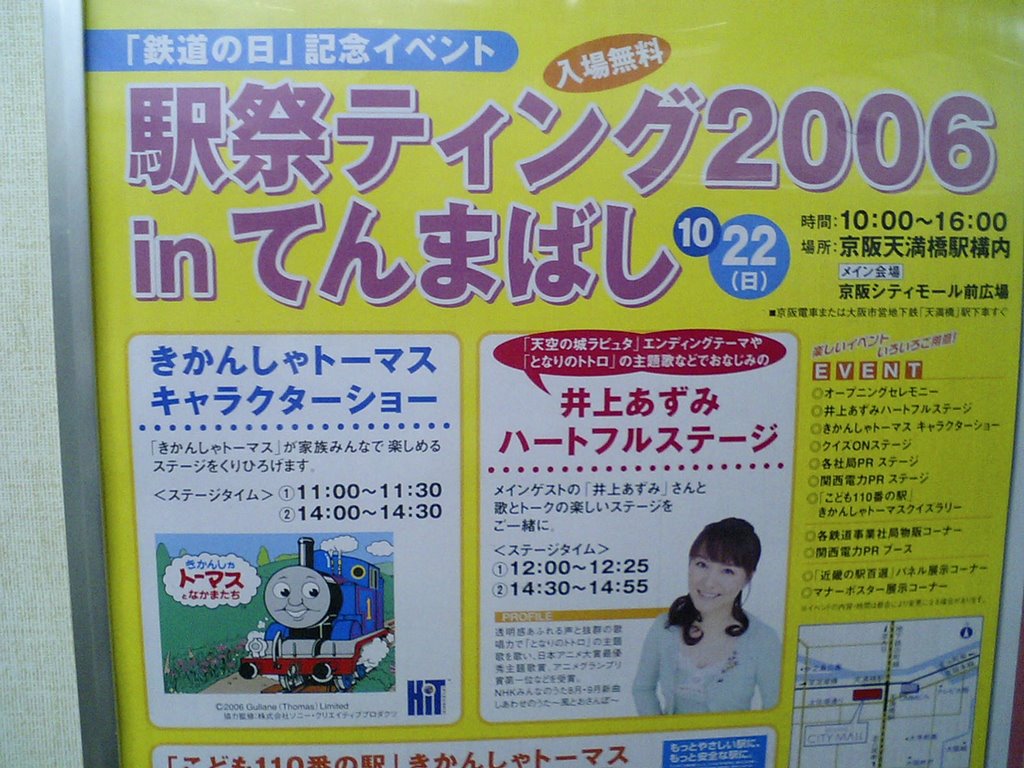
Punny Japlish


It took me a while to figure this out. The kanji in the upper left mean "station" and "festival". This is followed by katakana that is pronounced "tin-gu" and then the year, "2006". The pronuciation of the two kanji are "eki" and "sai" respectively.

Adding these all together, we get "eki-sai-tin-gu 2006" -- Exciting 2006, the name of an event sponsored by the Keihan Railway (Osaka) at one of the main stations, feature live performances, etc.

We can assume that the intended audience is expected to know enough English to decode this pun, although I suppose "Station Festival (gibberish) 2006" would still carry the main meaning. Certainly my mother-in-law would never have understood, but then, she isn't quite the type that the train line is intending to attract!

Sunday, August 27, 2006

English-into-Japanese topics

Here are some of the topics we will consider in future postings on this blog. Which pique your interest?

  • The standard theory says that Japanese has three writing systems -- katakana, hiragana and kanji. I'd like to argue that there are FOUR, with the English alphabet having become an integral part of written Japanese.
  • Students in junior and senior high school are forced to memorize long lists of English words. Yet, many of the words actually are used in Japanese in some form or another, perhaps with a very narrow meaning, or a meaning which doesn't quite match the usage in English. How much easier would the study of English be if the similarities were stressed in school teaching?
  • This is a fun one. Japanese remember and advertise phone numbers and other numbers using a set of pnemonics based on the various pronunciations of each number -- for example, 4129 -- yo-i-ni-ku -->yoi niku, "good meat". The English pronunciation of these numbers is also frequently used in order to extend the possibilities.
  • Signage in Japanese. This is part of my argument about English being integrated into Japanese. How many signs can you notice where important words in the sign are in English, but with no Japanese equivalent? Is there a system to this? Can we really say that the English is only there for the decorative effect?
  • Younger Japanese have no trouble pronouncing the /t/ in "two" correctly, while older people will still say /tsu/. How can we accommodate this and other new sounds in the phonemic system of Japanese?
  • Are new words from English ("gairaigo") replacing Japanese synonyms, or is most "gairaigo" simply used to fill gaps in Japanese vocabulary brought about by new developments in culture and technology?
  • One often hears the term "Japlish" or "Japalish" for various phenomena associated with the use of English in or by Japanese. This term, however, has diferent meanings depending on who uses it. Does it mean *errors* in the use of English by Japanese, or merely the use of Japanese elements (vocabulary or even grammar) in the use of English?
  • Other topics will be added to this as they come to mind!